GUARDIANS OF THE KARMIC AXIS: RAHU & KETU
If Saturn is the guru of karma, then Rahu and Ketu are the guardians of the karmic axis. They are the mathematical points where the orbits of the Moon and the Sun intersect; unlike other planets, they have no physical mass.
When the Moon moves from south to north crossing the ecliptic plane, the point of intersection is called Rahu (the North Node). Conversely, when the Moon moves from north to south, the intersection point is Ketu (the South Node). Eclipses occur when the Sun, Moon, and Earth align near these nodes.
Rahu and Ketu are also known as the dark lunar nodes because they symbolize the shadow sides of the psyche. But before delving deeper, it’s helpful to look at their mythological story.
The Myth of Rahu and Ketu
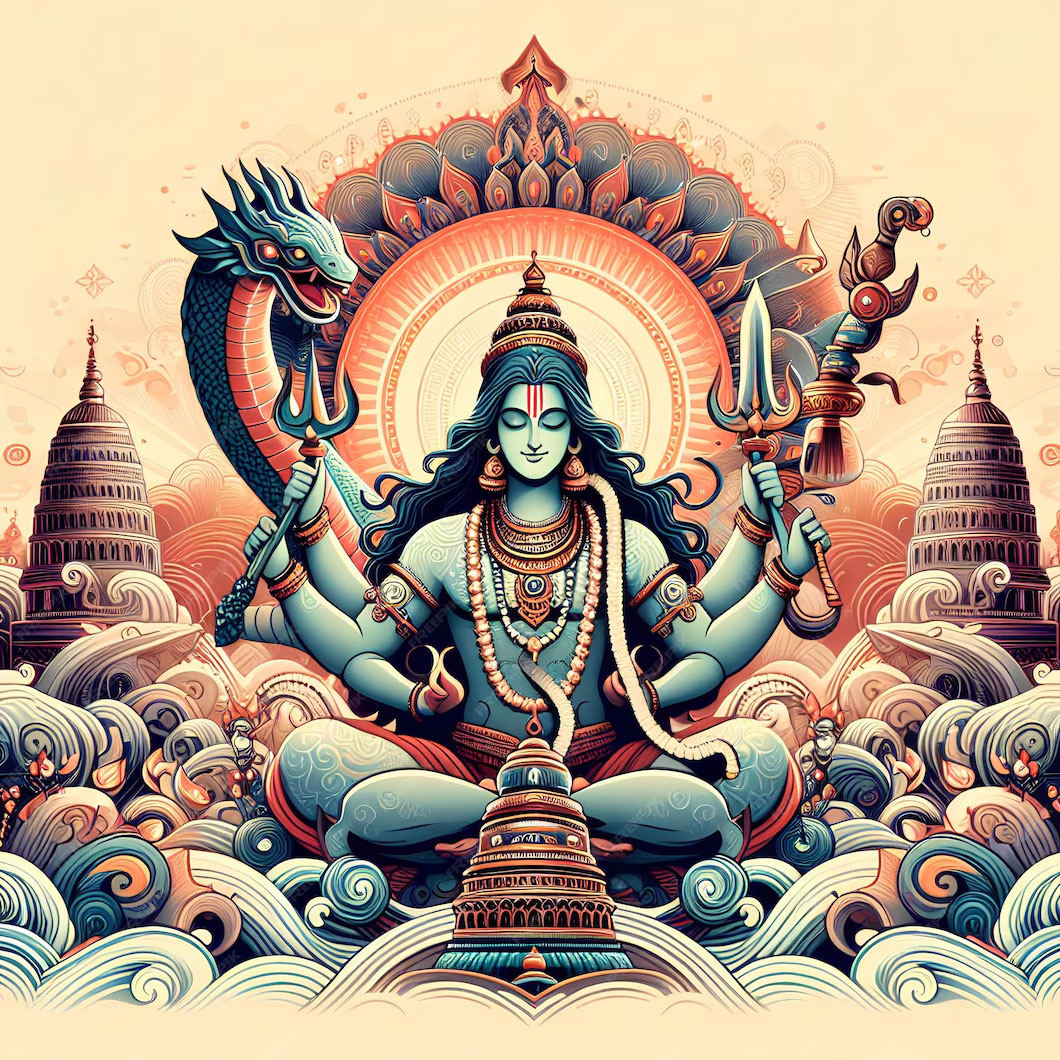
Long ago, Devas (gods) and Asuras (demons) fought to control the universe—one representing light, the other darkness. To gain eternal victory, the Devas sought Amrita, the nectar of immortality. An Asura named Vasuki, a wise serpent king, offered to help. Bound to Mount Mandara, he served as the churning rope in the cosmic ocean churning that produced the nectar.
After long effort, the Amrita emerged. Though the Devas agreed to share it with the Asuras, they changed their minds, fearing the Asuras would misuse the nectar. To deceive the Asuras, the Devas seduced and drugged them, then secretly drank the nectar themselves.
Vasuki, however, sensed the betrayal. As the Devas consumed the nectar, Vasuki placed himself between the Sun and Moon to secretly drink as well. But the Sun and Moon noticed and alerted Vishnu, who swiftly cut Vasuki in two with his discus. Though divided, Vasuki had become immortal. His head became Rahu; his tail became Ketu. Thus, Rahu and Ketu were born—two halves of the same being eternally seeking reunion.
This myth places Rahu and Ketu in the sky as points reminding the gods—and us—that in the quest for immortality, one must overcome the darkness within. Without embracing the shadow, true immortality and higher self-awareness remain unreachable.
Rahu and Ketu in the Birth Chart
In the natal chart, Rahu and Ketu are the Moon’s nodes, representing the shadow aspects of the psyche. Ketu points to unresolved karmic patterns from past lives, while Rahu indicates the areas in this life where the soul seeks new experiences and growth. The splitting of Vasuki symbolizes the severance from past-life ties.
The Rahu-Ketu axis is always exactly opposite each other in the chart. Working consciously on this axis supports the evolutionary growth of all planets and facilitates the soul’s overall progress. Each knot opened on this karmic axis marks a transition from one cycle to another.
Kundalini and Rahu-Ketu
The Kundalini energy, derived from kundal meaning “spiral” or “coil,” is the serpent energy dormant within us. When awakened, it ascends through the chakras, culminating in enlightenment—the soul’s reunion with infinite consciousness. This process is intimately connected to Rahu and Ketu.
How Do We Work with Rahu and Ketu Energies?
- Rahu energy points to life areas we feel drawn to experience but often hesitate or avoid due to fear and the unknown. Rahu may also represent excess and imbalance in those areas. For example, Rahu in the 10th house (career) might either push someone away from work or lead to workaholism. The challenge is finding balance in the soul’s focused area of growth.
- Ketu energy reveals unconscious patterns and attachments from past lives, often manifesting as automatic reactions or repetitive life themes we accept as fate. Recognizing and transforming these karmic residues is the first step toward freedom.
Approaching Rahu and Ketu as an integrated pair means courageously facing the fears and unconscious patterns inherited from the past and learning the art of surrender despite those fears.
Lorem fistrum por la gloria de mi madre esse jarl aliqua llevame al sircoo. De la pradera ullamco qué dise usteer está la cosa muy malar.